Water Damage in Apartments and Condos in Phoenix, AZ
Water damage in an apartment or condo is rarely a one-unit problem. The plumbing is shared, the leak is often upstairs, and the ceiling stain in your living room may belong to a pipe in someone else's bathroom. This page explains how water moves through multi-unit buildings in Phoenix, who handles what, and what to do first in your own unit.
Need help with water damage?
Call Now to reach a local water damage professional. Describe the water, where it is, and what it has touched.
Hours: Mon–Fri 7:00 AM–10:00 PM ET · Sat 8:00 AM–10:00 PM ET · Sun 7:00 AM–9:00 PM ET
Shared plumbing and upstairs-downstairs spread
An apartment or condo shares more than walls. Supply lines, drain lines, and vent stacks run vertically through the building, serving one unit above another, and a leak anywhere in that run can show up two floors away from where it started. The most common pattern in Phoenix multi-unit buildings is the upstairs-downstairs leak: a supply hose, toilet valve, or shower drain in the unit above lets go, and the water finds the ceiling of the unit below.
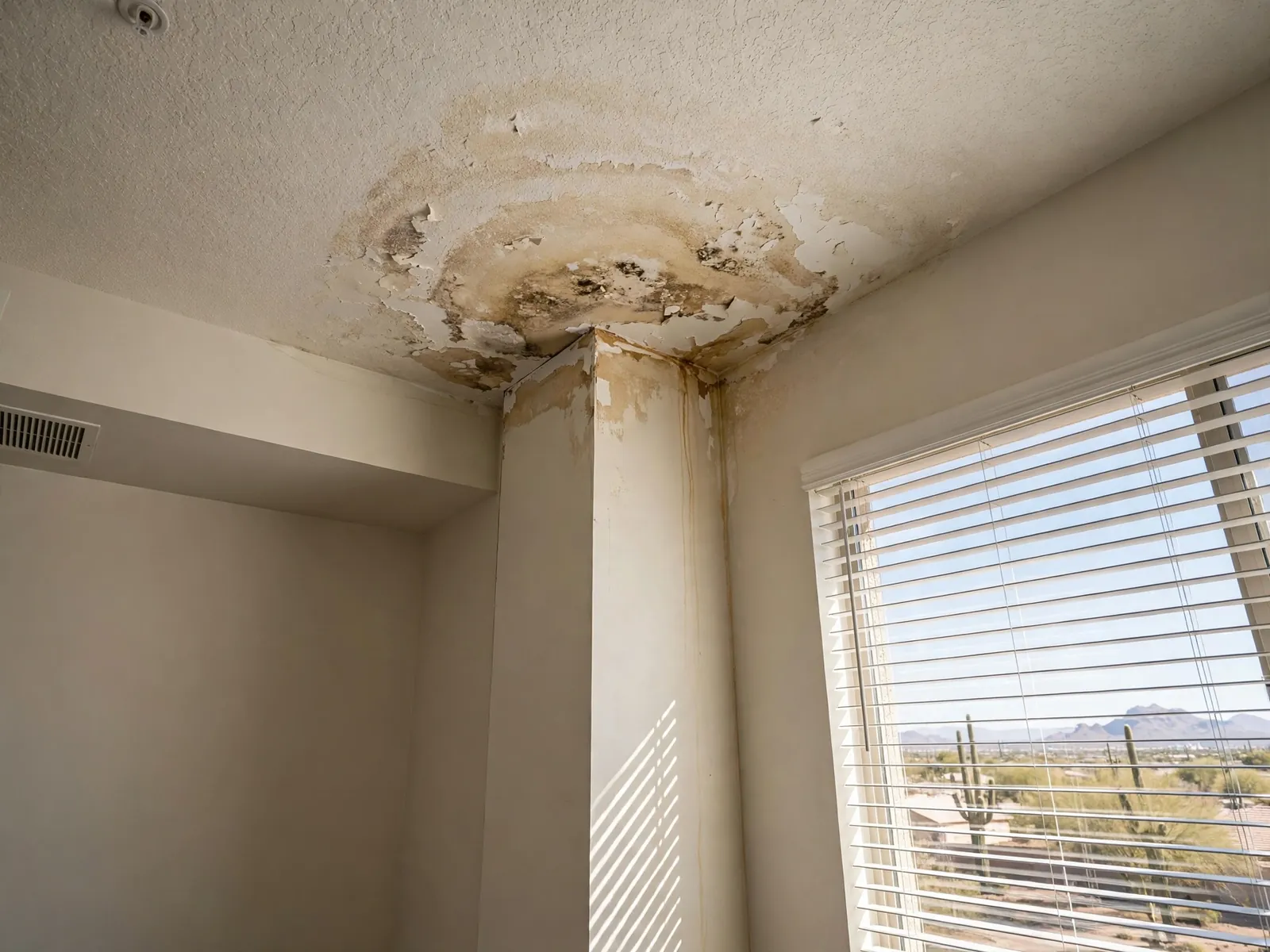
The ceiling is where the damage first appears, and it is also where the danger sits. A stain on the ceiling means water has already soaked through the floor above, the ceiling drywall, and possibly the insulation between them. A ceiling that sags or bulges is holding water — stay out from under it and call. Do not poke it, do not push on it, and do not put a bucket under it and wait: the weight of trapped water can bring a section of ceiling down.
Flat roofs add another shared path. Many Phoenix condo buildings have flat or low-slope roofs, and monsoon rain that ponds on a flat roof finds the weak point — a scupper, a drain, or the underlayment — and comes in through the top-floor ceiling. Rooftop AC units add their own route: a condensate drain that clogs on a rooftop package unit drips into the ceiling below, and the tenant underneath sees the stain before anyone thinks to check the roof.
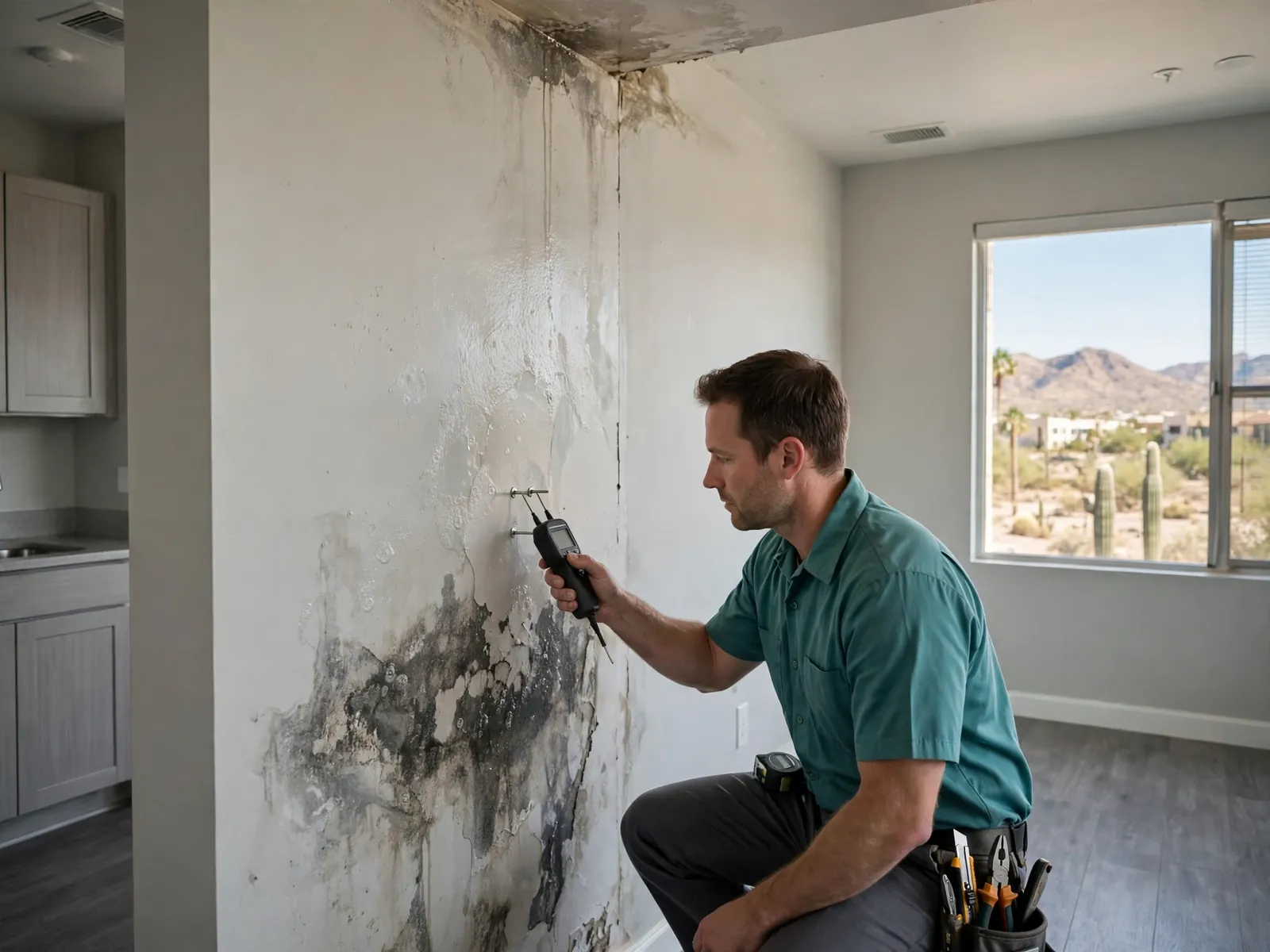
Finding the source in a multi-unit building means checking more than your own unit. Moisture meters read through drywall and flooring, so the wet area can be mapped without opening every wall — but the map has to include the unit above, the hallway, and the shared risers. A map that stops at your front door misses the source.
HOA vs owner vs tenant: who handles what
Three parties can be involved in a condo water problem, and each handles a different piece. The HOA — the homeowners association — usually handles the shared parts of the building: the roof, the exterior walls, the shared plumbing risers, the hallways, and the common areas. The unit owner handles what is inside their own unit: the fixtures, the supply lines within the walls of the unit, the flooring, and the interior drywall. The tenant, where there is one, handles their own belongings and the duty to report the water promptly.
Where the line falls depends on the association's governing documents, and those documents differ from one building to the next. A pipe inside a shared wall may belong to the HOA in one building and to the unit owner in another. That is why this page does not give a rule for who pays: the documents decide it. What this page gives is the order of operations — report the water, stop it if it is safe, get the standing water out, and let the documents sort out the bill while the drying is already under way.
In practice, the fastest path is to tell everyone at once: the neighbour upstairs if the water is coming from above, the HOA or property manager, and the unit owner if you are the tenant. Each of them can open a door the others cannot — the upstairs unit, the shared riser closet, the roof access. A leak that waits for a chain of phone calls is a leak that keeps spreading.
Insurance follows the same split. The HOA usually carries a policy for the shared building, the owner carries a policy for the inside of the unit, and the tenant carries a renters policy for belongings. Sudden, accidental water damage from inside the home is often covered by a standard homeowners policy, while flooding from outside usually needs a separate flood policy. Which policy answers depends on where the water started — another reason the source matters, and why it is written down.
Common areas: hallways, garages and lobbies
Water does not stop at unit doors. A burst riser in a hallway wall can send water along the corridor and under several doors at once. A garage below a leaking unit collects the water that comes through the ceiling, and a car parked underneath gets wet before anyone notices the stain. A lobby with tile floors hides standing water under rugs and mats, and the first person to find it is often the first person to slip on it.
Common-area water is the HOA's or manager's job to arrange, but it is every resident's job to report. If you see water in a hallway, a stairwell, or a garage, report it the same way you would report water in your own unit — and stay away from wet electrical fixtures, elevator buttons, and light switches in the area. Water and building electrical systems do not mix, and a wet hallway is not a place to wait for help.
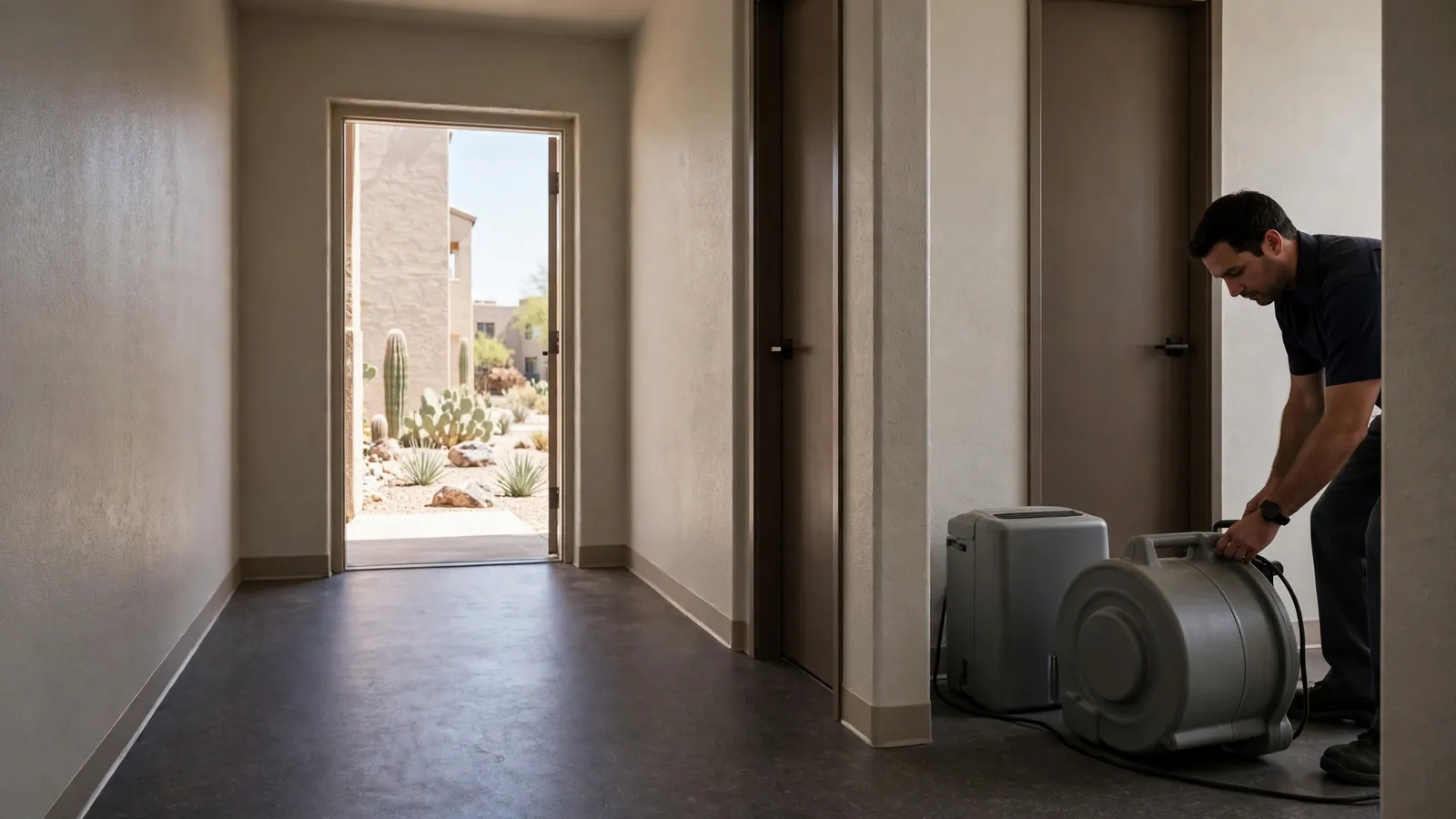
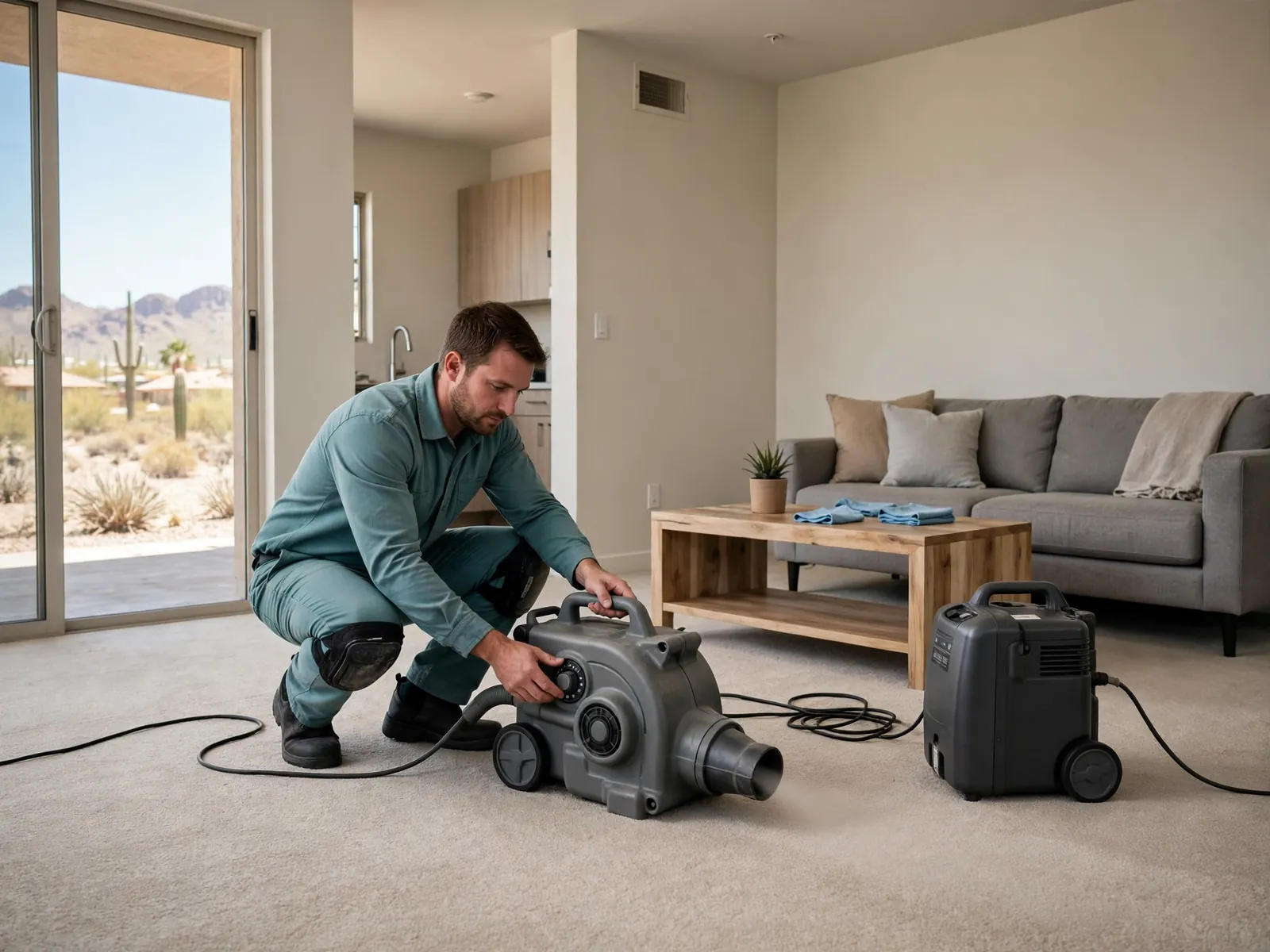
Drying a common area has its own constraints. Hallways and lobbies have to stay passable, so drying equipment is placed to keep a walkway clear. Garage drying has to work around parked cars and storage. The crew maps the wet area first, then places air movers and dehumidifiers where they dry the structure without blocking the building's daily use.
Documentation matters for common areas too. Photos of the water in the hallway or garage, the source if it can be seen, and the units it reached are the record the HOA needs for its own claim — and the record the affected unit owners need for theirs.
Ceiling damage from the unit above
A ceiling stain from the unit above is the most common water damage call in Phoenix apartments and condos, and it follows a pattern. It starts as a faint discolouration, often in a bathroom or kitchen ceiling, directly below the upstairs bathroom or kitchen. It grows darker over days, then the paint bubbles, then the drywall sags. By the time it sags, the ceiling has been wet for a while — and the insulation above it has been wet longer.
The source is usually one of a short list: a toilet supply valve or wax ring, a shower drain or pan, a sink supply hose, a dishwasher drain, or a washing machine hose in an upstairs laundry closet. All of them sit directly above the ceiling that shows the stain, which is why the map starts upstairs. Turning off the water to the upstairs fixture stops the flow; drying the ceiling below is the second job, and it starts only once the flow has stopped.
Drying a ceiling is not the same as drying a floor. Water sits in the ceiling drywall, in the insulation above it, and in the floor structure of the unit above. Moisture readings are taken from below, through the drywall, and the insulation is checked — wet insulation that stays wet loses its shape and holds moisture against the structure. In some cases the ceiling drywall has to be removed so the space above it can dry; in others it can be dried in place. The readings decide, not the look of the stain.
A stain that dries on its own is not proof the ceiling is dry. The surface can look dry while the inside of the drywall and the insulation above it are still wet, and the smell arrives weeks later. That is why a ceiling stain is checked with a meter even when it looks old and dry — and why the upstairs source is checked at the same time, so the stain does not come back with the next shower.
Documentation: whose insurer, what to photograph
In a multi-unit leak, documentation serves three claims at once: the unit below, the unit above, and the building. Photos come first — the water, the stain or the sag, the source if it can be seen, and every room the water reached, in both units where access allows. Take them before anything is moved or dried, because the water level and the spread are the facts that disappear first.
Moisture readings are the second record. The crew writes down what was wet at the start, what the drying plan covers, and what the readings were when the job finished. In a multi-unit job the readings should cover both units and the space between them — the ceiling of the lower unit and the floor of the upper one — so that neither side has to guess whether the structure between them is dry.
The third record is the written scope: what work was done, which materials were removed, and what was dried in place. The HOA, the unit owner, and the tenant each need a copy for their own claim, because each policy asks for the same facts from a different angle. If the question of who pays comes up later, the scope is the document that shows what was actually done and why.
One practical point: get the name and contact details of the person who arranged the work, and the date and time the water was first found. Multi-unit claims move slowly, and the facts that are obvious on the day of the leak — who found it, when, and where the water was — are the facts that get argued about a month later.
What to do first in your unit
If you find water damage in your apartment or condo, start with the same first steps as any water damage, then add the multi-unit step. Shut off the main water supply if it is safe to do so — in a condo the shutoff is often inside your unit, near the water heater or under a sink — or shut off the fixture valve if the leak is clearly from one fixture. Move valuables, rugs, and electronics off wet floors. Stay away from wet outlets, switches, and light fixtures. Take photos.
Then tell the neighbour above you, if the water is coming from above, and tell the HOA or property manager. Both need to know right away: the neighbour can shut off their fixture, and the manager can arrange access to the shared risers and the roof. Do not wait for one to tell the other — tell both, and tell them now.
If the ceiling is sagging or bulging, stay out from under it and keep everyone else out too. Do not poke it or push on it. Move furniture out of the way if you can do so safely, and put a bucket on the floor only if the ceiling is dripping and you can do it without standing underneath. The ceiling is holding water, and its weight is what brings it down.
If the water is sewage water — from a toilet backup or a drain that has come back up — keep people and pets away from it, do not run taps or flush, and call for help rather than cleaning it with household tools. Sewage water is treated as contaminated water throughout, and the cleanup is a different job from a clean water leak.
Services used most
Water Damage Restoration · Structural Drying & Dehumidification · Ceiling Water Damage · Emergency Water Extraction
Where we work
Related guides
Ceiling Water Damage: Can It Be Fixed? · Does Homeowners Insurance Cover Water Damage?
Related problems
Frequently asked questions
Questions people ask about water damage in apartments and condos, answered plainly.
It depends on the association's governing documents, which differ from building to building. As a rule the HOA handles shared parts — roof, exterior walls, shared plumbing risers and common areas — the unit owner handles what is inside their own unit, and the tenant handles their own belongings and reports the water promptly. The documents decide where the line falls.
Tell the neighbour above you and the HOA or property manager right away — both need to know. The neighbour can shut off their fixture, and the manager can arrange access to the shared risers. In your own unit, move valuables off wet floors, take photos of the stain and the water, and stay out from under a ceiling that sags or bulges.
It can be. A stain means water has already soaked through the floor above and the ceiling drywall. If the ceiling is sagging or bulging, it is holding water — stay out from under it and call. If the stain is dry and flat, it still needs a moisture reading, because the surface can look dry while the inside of the drywall and the insulation above it are still wet.
Yes — that is the usual pattern. Supply lines, drain lines and vent stacks run vertically through the building, so a leak in one unit can show up in the unit below, the hallway, or the garage underneath. A burst riser in a hallway wall can send water under several doors at once.
A riser is a vertical pipe run that serves several units stacked above each other — supply lines, drain lines and vents. When a riser leaks, the water can appear floors away from the leak itself, which is why finding the source means checking the shared runs, not only the unit with the stain.
Moisture readings are taken from below, through the drywall, and the insulation above the ceiling is checked. In some cases the ceiling can be dried in place with air movers and dehumidifiers; in others the wet drywall has to be removed so the space above it can dry. The readings decide, not the look of the stain.
The water itself, the stain or sag in the ceiling, the source if it can be seen, and every room the water reached — in your unit, and in the unit above where access allows. Take them before anything is moved or dried. The HOA, the unit owner and the tenant each need the same photos for their own claims.
It depends on how much is wet and whether the ceiling is safe. A small, flat stain with no sagging may allow you to stay while drying equipment runs, though the equipment is loud. A sagging ceiling, sewage water, or a large wet area may mean staying elsewhere until the readings show the structure is dry. The crew on site can advise based on what the readings show.
Many Phoenix condo buildings have flat or low-slope roofs, and monsoon rain that ponds on a flat roof finds the weak point — a scupper, a drain, or the underlayment beneath the roof surface. Monsoon season runs June 15 to September 30, and a single heavy burst can overwhelm a roof drain that handled lighter rain all year.
Water damage in your Phoenix home or business?
Call Now to reach a local water damage professional. Describe the water, where it is, and what it has touched.
Call now for water damage help
Tap Call Now to reach a local water damage professional. Tell them where the water is, what it has touched, and whether it is still coming in.
Hours: Mon–Fri 7:00 AM–10:00 PM ET · Sat 8:00 AM–10:00 PM ET · Sun 7:00 AM–9:00 PM ET
Before you call
- Shut off the main water supply if it is safe to do so.
- Move valuables, rugs and electronics off wet floors.
- Take photos of the water and the damage for your records.
- Stay away from wet outlets, switches and light fixtures.
- Note when the water started and what caused it, if you know.