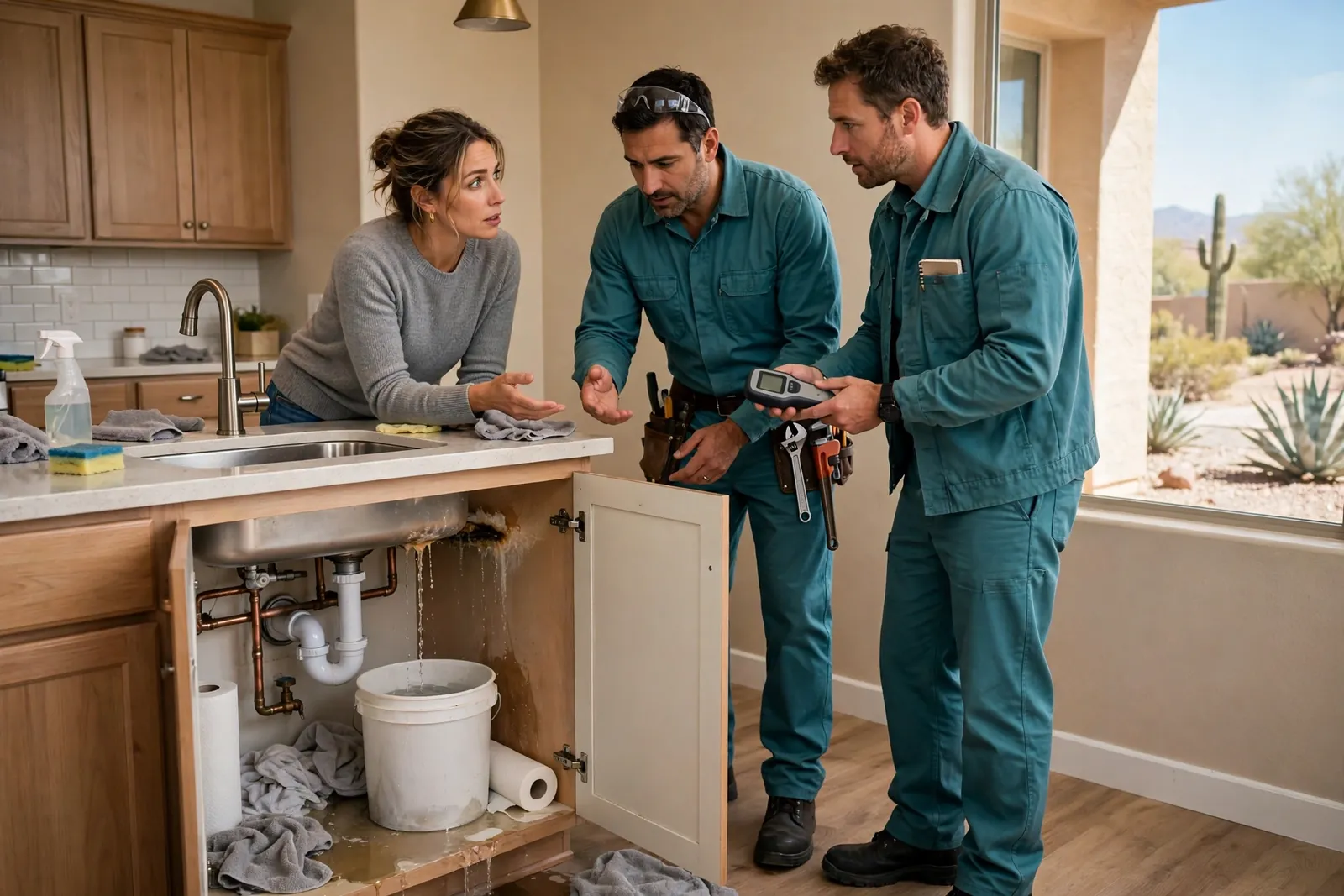
Who To Call First for Water Damage in Phoenix: Plumber, Restoration, or Insurer?
Water is coming in and three numbers compete in your head: the plumber, the restoration company, and your insurer. The right first call depends on what the water is doing — this guide walks through each situation.
Phoenix Water Damage Pros · 2026-11-16 · Emergency Guide
The short version
Problem: You have three calls to make — plumber, restoration, insurer — and the order depends on what the water is doing right now.
What to do: Stop the water if it is safe, then call for the standing water first; the plumber fixes the source, restoration handles the water and drying, and the insurer is told once the water is under control.
When to call: Call now if water is still coming in, if it is sewage water, if a ceiling is sagging, or if water is near electrical fixtures.
The short answer: it depends on what the water is doing
Three numbers compete in your head when water damage happens: the plumber, the restoration company, and your insurer. The right first call depends on what the water is doing right now — and the wrong order costs time, because water does not wait for a decision.
Think of it as three jobs, not three companies. Somebody has to stop the water. Somebody has to deal with the water that is already on the floor, in the walls, and under the flooring. And somebody has to pay for it. Those are three different jobs, done by three different parties, in an order that follows the water — not the phone book.
The order is simple once the jobs are separated. Stop the water first, if it is safe to do so. Get the standing water out second. Tell your insurer third, once the water is under control and you can describe what happened. The rest of this guide walks through each situation, so you can find yours and follow it.
If water is still coming in: shut it off, then call a plumber
Water that is still coming in is a source problem, and the source is a plumber's job. A burst supply line, a failed fitting, a water heater that has let go, or a toilet valve that will not close — all of them keep filling the house until the water is shut off. The first step is the shutoff itself: the fixture valve if the leak is clearly from one fixture, or the main supply at the meter box near the street or on the house wall near the water heater.
If you cannot find the shutoff, or if reaching it means wading through water near electrical fixtures, do not go looking — call. Stay away from wet outlets, switches, and light fixtures, and keep everyone else away too. A plumber can shut the water off at the meter; a restoration crew can extract the water that has already spread. Either call stops the damage from growing, but the plumber is the one who fixes the source.
Once the water is off, the second call is for the water itself. Extraction removes the standing water, moisture meters map what soaked into the walls and floors, and drying equipment is placed on the mapped wet areas. The plumber does not dry the house, and the drying crew does not fix the pipe — each one does their own half, and the handover between them is part of the job.
One mistake to avoid: calling the insurer first while the water is still coming in. The insurer needs to know, but they cannot stop the water. Call them once the flow has stopped and the water is being dealt with — and have your photos and your notes ready, because the claim is built on what you can describe.
If there is standing water: extraction comes first
Standing water on the floor is a restoration job first. The water is already out of the pipe and onto the floor, and the job now is to get it out before it spreads further — into the drywall, under the flooring, and into the next room. Extraction machines pull water from hard floors, carpet and pad, and low spots where water collects, far beyond what a household wet vacuum can move.
In a Phoenix home, most of the floor sits on a concrete slab, so water spreads sideways across the slab and wicks up into drywall, baseboards, and flooring. What looks like a small puddle in the kitchen can be wet carpet in the next room and a damp wall behind it. Extraction deals with the water you can see; the moisture check that follows deals with the water you cannot.
Call for extraction while the water is still there, not after you have mopped it up. Many homeowners mop first and call later, once the floor looks manageable — and by then the water has had an hour or more to wick into drywall and under flooring, and the job has grown from extraction into drying and removal. Calling while the water is still on the floor keeps the wet area small.
The plumber still matters here, but second. If the source is a burst pipe or a failed fitting, it has to be fixed — or the water will come back the moment the extraction stops. The drying crew can tell you where the water came from; the plumber fixes it.
If the water is sewage or flood water: stay away and call
Sewage water and flood water are different from clean water, and the first call is different too. Do not try to clean it yourself, do not run taps or flush, and do not mop it up with household tools. Keep people and pets away from it, stay away from wet electrical fixtures, and call for help.
Sewage water is treated as contaminated water throughout. The cleanup involves removing contaminated materials, not only drying them — and the crew that handles it brings its own equipment and its own protection. Flood water from outside is treated the same way: water that comes in from a storm, a wash, or a flooded street carries what the street carries, and it is not water to mop up.
A plumber is still part of this job — a sewage backup often comes from a clogged or broken drain line, and that line has to be cleared or fixed. But the plumber comes after the contaminated water is handled, not before. The order is: keep everyone away, call for the cleanup, then deal with the drain.
Your insurer needs to know about sewage and flood water, but the same order applies: water first, claim second. Flood water from outside usually needs a separate flood policy, and sewage backup often needs a separate endorsement on a homeowners policy — so the call to the insurer is also the call that finds out what is covered. Have your photos ready: the water, the rooms it reached, and the source if you can see it.
If the leak is slow and hidden: detection and drying
Some leaks do not announce themselves. A damp patch on a wall, a musty smell, a floor tile that feels warm, a water bill that rises without explanation — these are the signs of a slow leak, and the first call is for detection and drying, not for a plumber. The question is not how to stop the water, but where the water is and how far it has spread.
A slab leak is the classic Phoenix slow leak: a pipe under the concrete floor that lets go a little at a time. The signs are a warm patch on the tile, damp flooring, the sound of running water when the taps are off, and a bill that rises without explanation. A meter test — comparing the water meter reading with all taps off — can confirm that water is running somewhere it should not be.
An AC condensate leak is the other slow leak, and the Valley's most common summer cause. Hard water leaves mineral buildup in the drain line, the line clogs, the pan overflows, and the attic air handler drips onto the ceiling below. The signs are a ceiling stain, a drip from the ceiling, or a float switch that has shut the AC off. The drain line is a maintenance job; the water it left behind is a drying job.
For a slow leak, the insurer call can wait until the map exists. The moisture readings show what was wet, the written scope shows what was done, and the photos show the water and the damage. A claim built on a map and a scope is a claim that can be explained; a claim built on a smell and a stain is not.
What each party does — and does not do
The plumber fixes the source. Supply lines, fittings, valves, drain lines, water heaters — the pipe and the fixture are the plumber's work. The plumber does not dry the house, map the hidden water, or write the drying record. If the plumber fixes the pipe and leaves, the water that has already soaked into the walls and floors is still there.
The restoration crew handles the water. Extraction of standing water, moisture mapping with meters, drying with air movers and dehumidifiers, removal of materials that cannot be dried, and the readings that confirm the job is dry. The crew does not fix the pipe, replace the water heater, or rebuild the wall. The drying job ends when the readings show dry; the rebuild is a separate step, arranged separately.
The insurer decides what is covered. Sudden, accidental water damage from inside the home is often covered by a standard homeowners policy. Flooding from outside usually needs a separate flood policy. Sewage backup often needs a separate endorsement. The insurer does not stop the water, dry the house, or fix the pipe — they need the photos, the readings, and the written scope to decide the claim.
The rebuild — new drywall, new flooring, new paint — is a fourth job, and it comes after the drying is confirmed. No page on this site promises a rebuild, a timeline for one, or a finish. What the call arranges is the mitigation: the water stopped, the wet areas mapped and dried, and the readings that show when it is dry.
What to say on the call
A good call is short and specific. Say where the water is: which room, which floor, and what it has touched. Say how deep it looks, and whether it is still coming in. Say what caused it, if you know — a burst pipe, a water heater, a roof leak, a sewage backup. And say what you have already done: whether the water is shut off, whether you have moved valuables, and whether anyone is in the wet rooms.
Four sentences cover it: "The water is in the kitchen and the hallway. It is still coming in from under the sink. I have shut off the main supply. The floor is wet and the baseboards are damp." That is enough for the crew to decide what equipment comes to the door — and it is more useful than ten minutes of background.
If you are calling for someone else — a tenant, a neighbour, a parent — say so, and say who can let the crew in. Access decides how fast the job starts: a crew that cannot get in cannot extract water. Give the name and number of the person on site, and the name of the person who will pay or claim, if they are different people.
If the call is to your insurer, the same facts apply, plus two more: when the water started, and what you have photographed. The insurer will ask when it happened, what caused it, and what it touched. The photos and the notes you took while the water was still there are the answers.
What to document before anyone arrives
Documentation starts before the crew arrives, because the water level and the spread are the facts that disappear first. Photograph the water itself, the source if you can see it, and every room the water reached. Photograph the floor, the walls at the base, and the ceiling if it is stained or sagging. Take them before anything is moved or dried.
Write down the time the water was found, and the time it started if you know it. Write down what caused it, if you know — and write "do not know" if you do not. Write down what the water touched: flooring, walls, furniture, belongings, equipment. That list is the claim, and it is far easier to write while the water is still there than to reconstruct a week later.
Keep the photos and the notes together, and keep a copy for yourself — not only with the crew's paperwork. The crew will add their own record: the moisture readings from the start of the job, the written scope of what was done, and the readings when the job finished. Your photos and their readings are the two halves of the same record.
One practical point: do not throw anything away before it is photographed. Wet flooring, wet drywall, wet belongings — once they are gone, the claim has no record of them. Photograph first, remove second.
When to call your insurer — and what they need to hear
Call your insurer once the water is under control — the flow stopped, the standing water being dealt with — and you can describe what happened. The insurer needs four facts: when the water started, what caused it, what it touched, and what you have done so far. The photos and the notes are the answers to all four.
The insurer will ask whether the damage was sudden or gradual, because that decides coverage. Sudden, accidental water damage from inside the home is often covered by a standard homeowners policy. A leak that ran for weeks before anyone noticed is a harder claim — which is why the date the water was found, and the date it started if you know it, matter so much.
Flooding from outside is a different policy. Water that comes in from a storm, a wash, or a flooded street usually needs a separate flood policy — a standard homeowners policy does not cover it. Sewage backup often needs a separate endorsement as well. If you do not know what your policy covers, the call to the insurer is also the call that finds out.
Do not wait for the insurer before stopping the water or extracting it. The insurer expects you to limit the damage — shutting off the supply, moving valuables, and getting the water out are the steps that keep a claim from growing. The EPA notes that mold can begin to grow on damp surfaces within 24 to 48 hours, so the drying starts the same day where possible, and the claim follows the work — not the other way round.
Related: burst pipe problem · water heater leak water damage · water damage help in Phoenix
Related guides
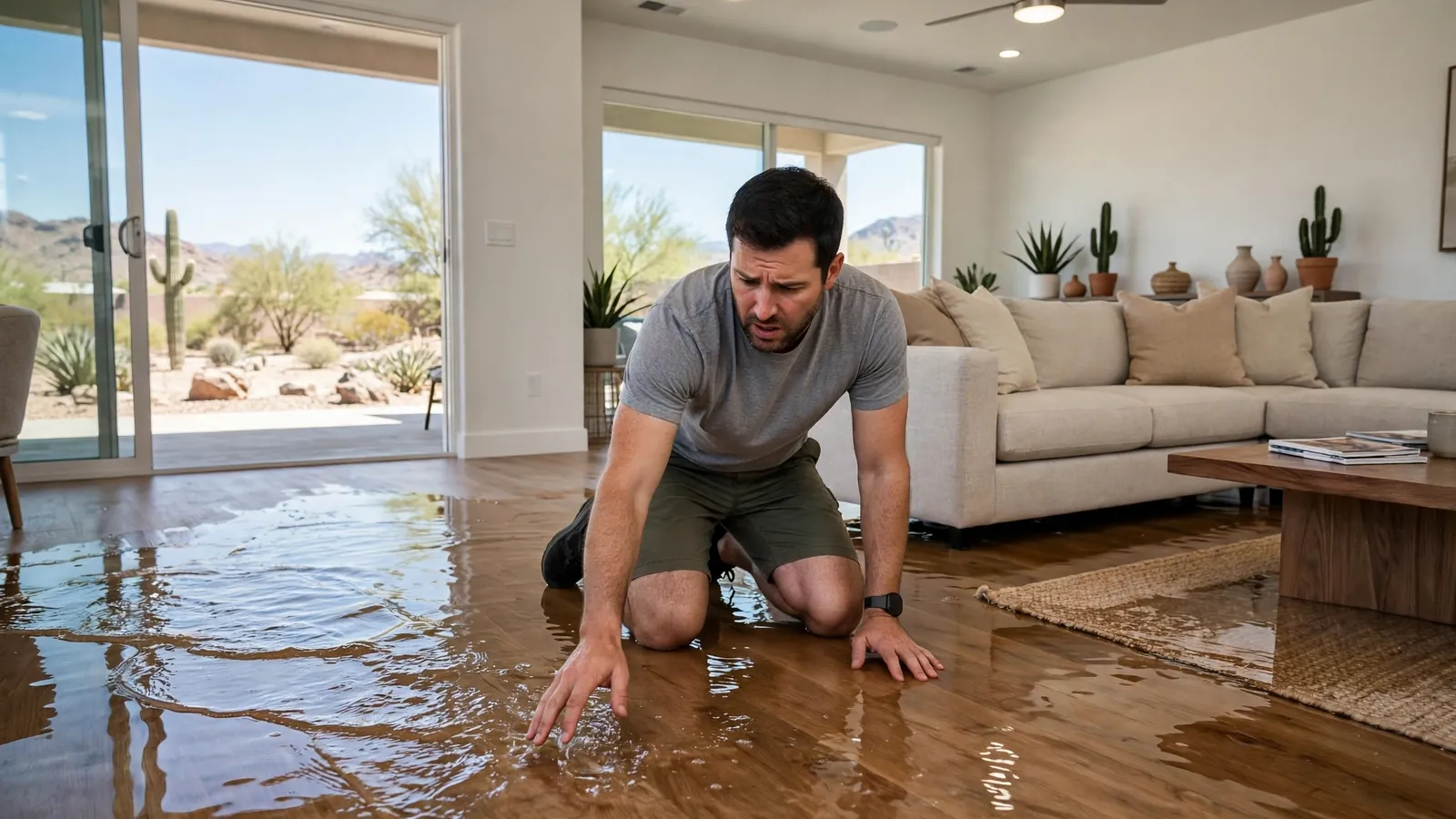 Emergency Guide
What To Do First When Water Floods Your Home
Water on the floor and rising? The first ten minutes decide how bad the damage gets. Here is what to do first, in order — and what not to do.
 Insurance Guide
Does Homeowners Insurance Cover Water Damage?
The answer depends on how the water got in, not how much damage it caused. Sudden and accidental is usually covered; gradual and flood usually are not. Check your policy.
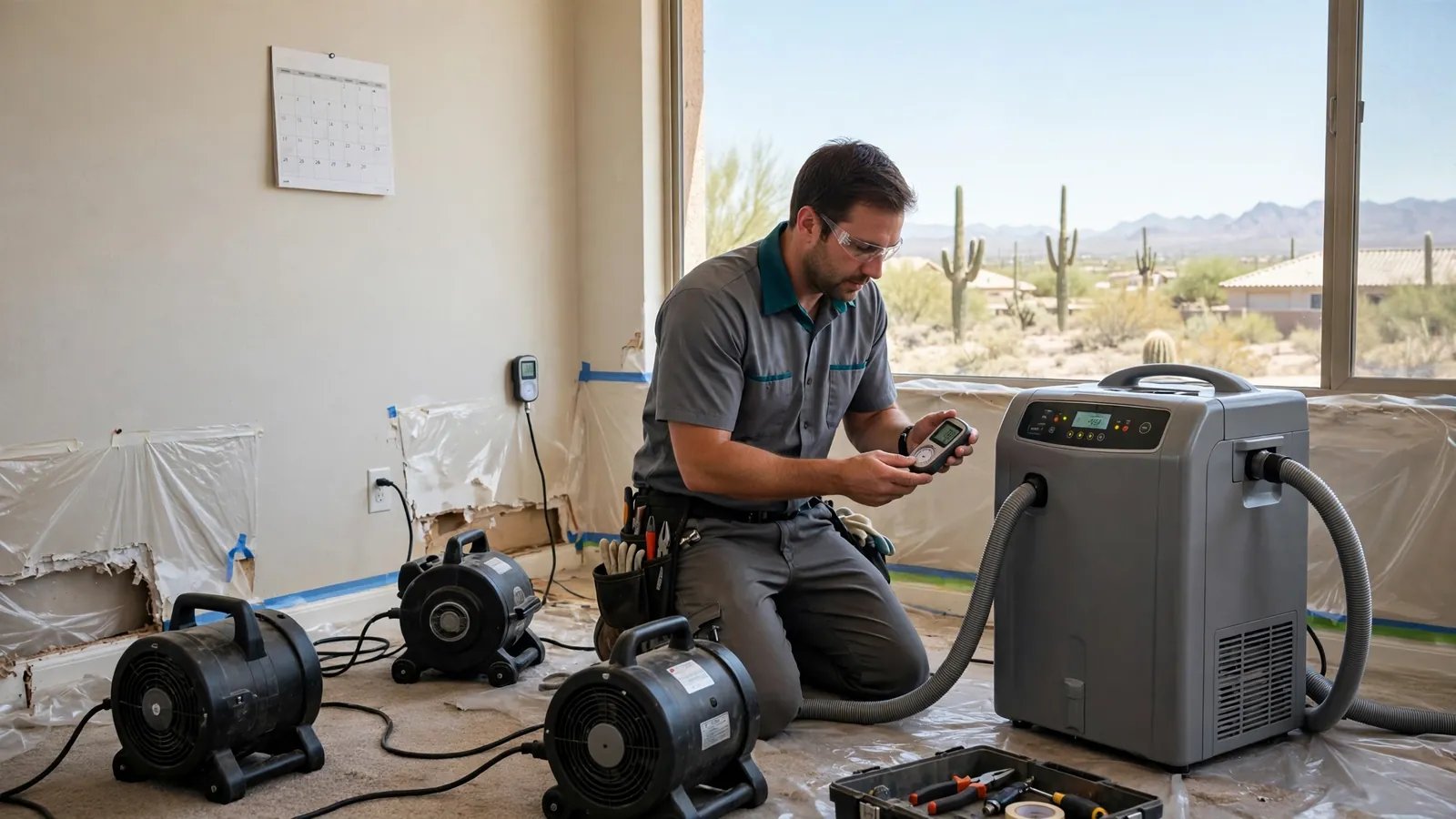 Restoration Guide
How Long Does Water Damage Restoration Take?
There is no fixed number of days. The timeline depends on the water, the materials, and the readings — here is how it is decided, step by step.
Frequently asked questions
Questions people ask about this topic, answered plainly.
It depends on what the water is doing. If water is still coming in, shut it off if it is safe to do so and call a plumber for the source — then call for extraction of the standing water. If the water is sewage or flood water, stay away and call for the cleanup. Tell your insurer once the water is under control and you can describe what happened.
If water is still coming in, yes — the plumber fixes the source, and the water keeps coming until the source is fixed. If the water has already stopped and the job is the water on the floor and in the walls, call for extraction and drying first, and the plumber second for the pipe or fixture. Each one does their own half.
Once the water is under control — the flow stopped, the standing water being dealt with — and you can describe what happened: when it started, what caused it, what it touched, and what you have done so far. Do not wait for the insurer before stopping the water or extracting it; the insurer expects you to limit the damage.
Call for detection and drying. Moisture meters and a thermal camera map where the water is and how far it has spread, even when the source is not obvious. A slab leak, an AC condensate leak, or a pipe inside a wall can all hide their source — the map finds it, and the plumber or roofer fixes what the map points to.
Call for the cleanup first — sewage water is treated as contaminated water throughout, and the cleanup involves removing contaminated materials, not only drying them. Keep people and pets away from it, do not run taps or flush, and do not try to clean it with household tools. A plumber clears or fixes the drain line after the contaminated water is handled.
Yes, if the source is a pipe, a fitting, a valve, or a water heater — it has to be fixed, or the water will come back the moment the drying stops. The drying crew can tell you where the water came from; the plumber fixes it. If the source was rain through a roof leak, the fix is a roofer, not a plumber.
Where the water is, how deep it looks, whether it is still coming in, what caused it if you know, and what it has touched. Then what you have already done — whether the water is shut off, whether you have moved valuables — and who can let the crew in. For your insurer, add when the water started and your photos.
Still have questions?
Call Now to reach a local water damage professional — describe the water and the rooms it reached.
Call now for water damage help
Tap Call Now to reach a local water damage professional. Tell them where the water is, what it has touched, and whether it is still coming in.
Hours: Mon–Fri 7:00 AM–10:00 PM ET · Sat 8:00 AM–10:00 PM ET · Sun 7:00 AM–9:00 PM ET
Before you call
- Shut off the main water supply if it is safe to do so.
- Move valuables, rugs and electronics off wet floors.
- Take photos of the water and the damage for your records.
- Stay away from wet outlets, switches and light fixtures.
- Note when the water started and what caused it, if you know.