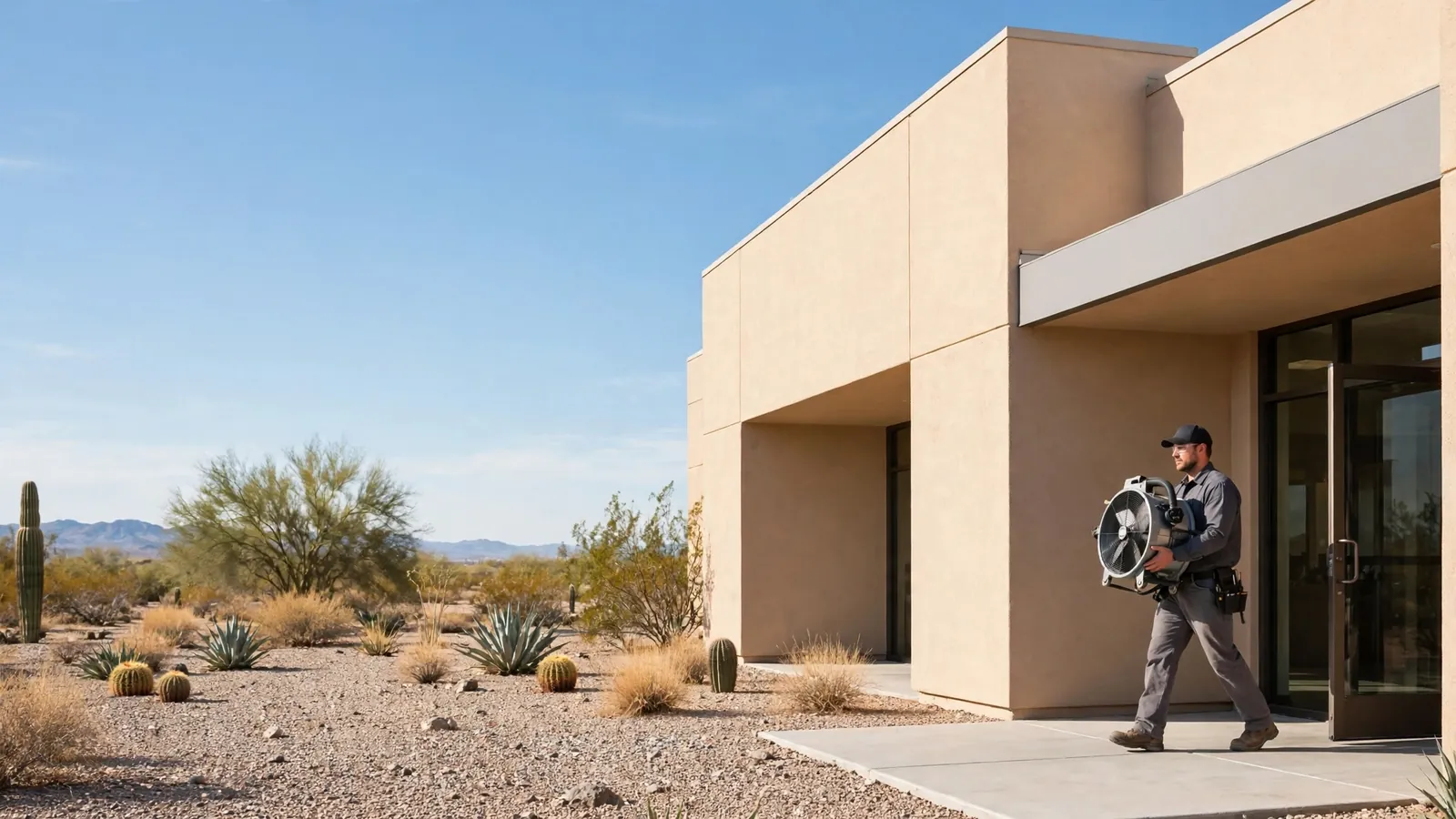
Commercial Water Damage Restoration in Phoenix, AZ
Water damage in an office is a business problem before it is a building problem. Every hour the space is closed is an hour of work that does not happen, and every wet room is a room full of equipment, documents, and people who need to keep working. This page explains how commercial water damage work differs from a home job — occupied space, after-hours access, shared building systems, and the documentation a business claim needs.
Need help with water damage?
Call Now to reach a local water damage professional. Describe the water, where it is, and what it has touched.
Hours: Mon–Fri 7:00 AM–10:00 PM ET · Sat 8:00 AM–10:00 PM ET · Sun 7:00 AM–9:00 PM ET
Business interruption: every hour closed
The first cost of water damage in an office is not the repair — it is the interruption. A wet conference room is a meeting that moves. A wet server room is a system that goes down. A wet reception area is a front door that cannot open. In a Phoenix office building, where summer heat already pushes cooling systems hard, a leak that takes a floor out of use in July is a leak that lands in the busiest weeks of the year.
That is why the first question on a commercial call is not only where the water is, but what the space does. A call centre floor, a law office with paper files, a medical office with patient rooms, and a tech office with a server closet are four different jobs, even when the leak is the same. The drying plan follows the use of the space, not only the size of the wet area.
Speed matters differently in a commercial job. In a home, the question is how fast the rooms are dry. In an office, the question is how fast part of the space can reopen — which rooms can be isolated, which can keep working, and which have to close until the readings show dry. A good drying plan is a phased plan: the rooms that can reopen do, and the rooms that cannot stay closed until the moisture readings say otherwise.
Phoenix offices add their own causes. Downtown and Central Avenue office buildings often have older risers and shared restrooms on every floor — a toilet supply valve or a restroom drain on the tenth floor sends water down through the floors below. Tempe and Chandler tech corridors have dense server and equipment rooms, where a small leak over a rack matters more than a large leak over an empty corridor. Scottsdale offices add flat roofs and rooftop units, where a monsoon burst ponds water over a ceiling full of ductwork and cabling.
Occupied-space work: isolating areas so parts stay open
Most office water damage is handled while the building is still in use. The crew isolates the wet area — with barriers, with containment, with drying equipment placed to keep walkways clear — so the rest of the floor keeps working. That is the core skill of commercial work: drying a building that cannot stop.
Isolation starts with the map. Moisture readings show exactly which rooms are wet and which are dry, so the barriers go around the wet rooms only. A floor that is mapped properly loses two rooms, not the whole floor. A floor that is guessed at loses the whole floor, because nobody knows which rooms are safe to use.
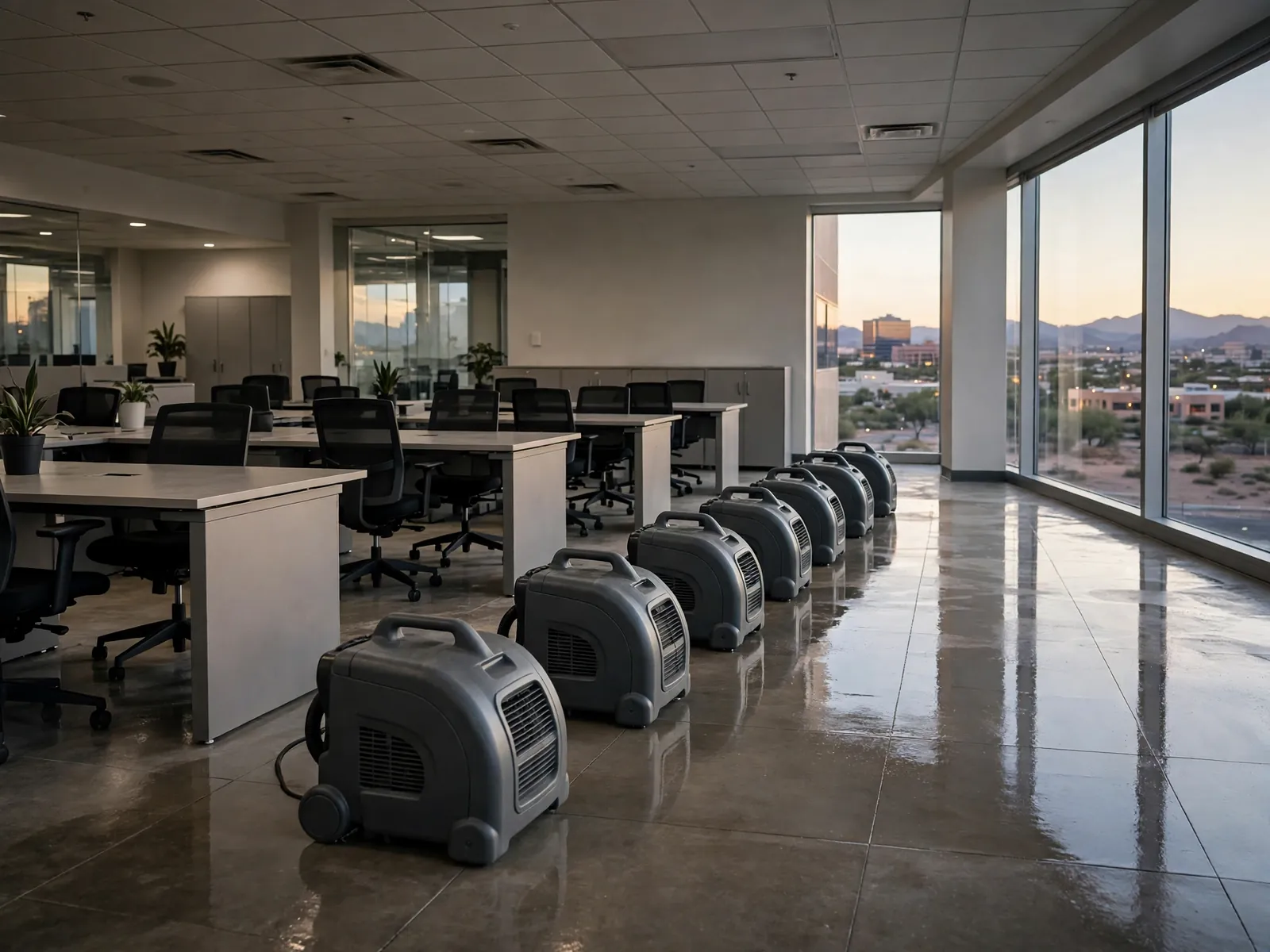
Noise is part of the negotiation. Air movers and dehumidifiers are loud, and they run for days. In an occupied office that means placing equipment where it dries the structure without sitting next to a desk where someone is trying to work — or, where that cannot be done, scheduling the loudest work for the hours when the floor is empty. The drying does not stop for office hours, but the placement can be planned around them.
Safety comes first in occupied space. Wet floors are slip hazards, wet ceilings can sag, and wet electrical fixtures are a risk to everyone on the floor. Areas with sagging ceilings or wet outlets are closed off, not worked around. The crew marks what is closed and what is open, and the building manager tells the staff — so nobody walks into a wet room because nobody told them it was wet.
After-hours access and tenant notices
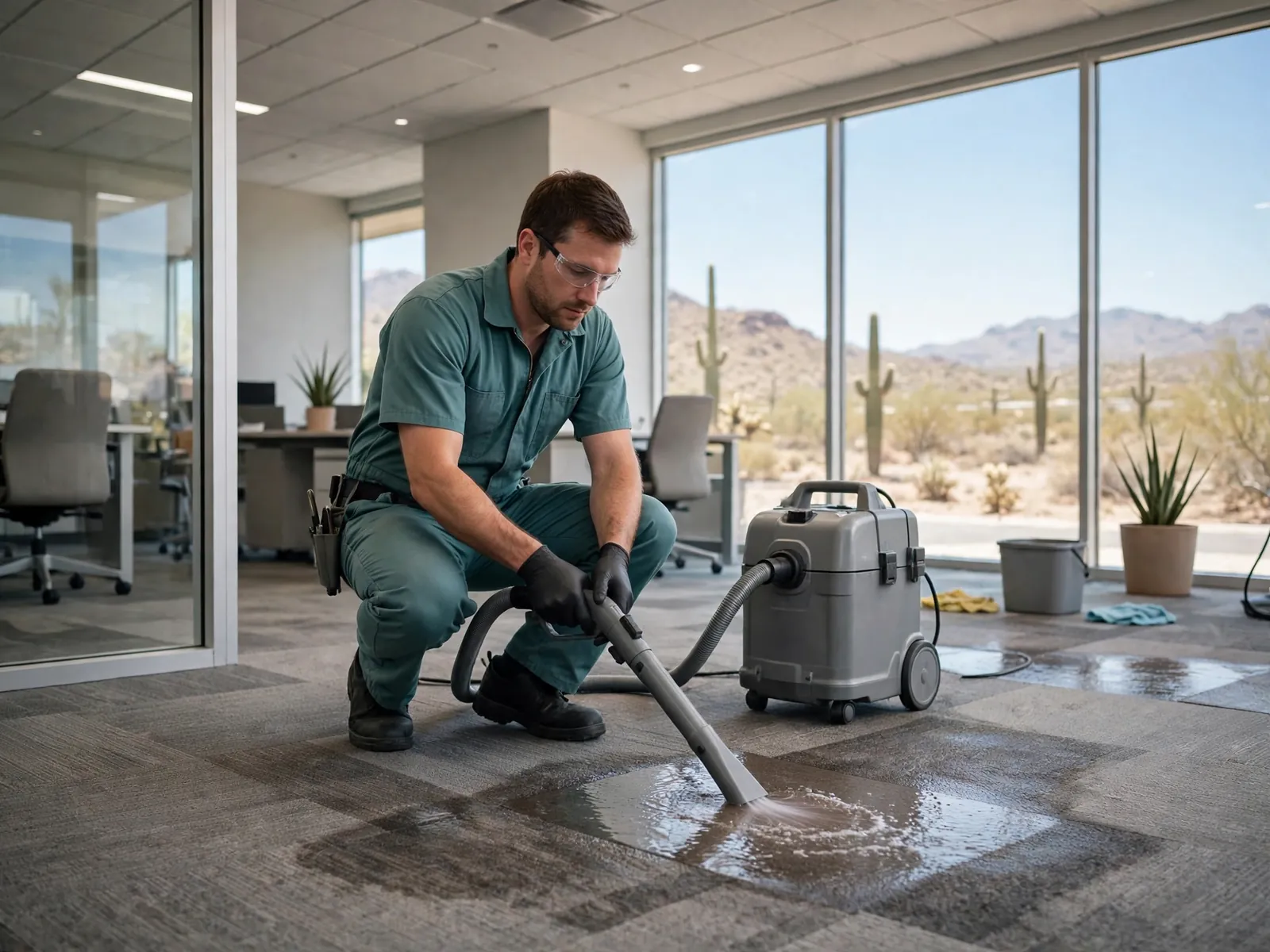
A large share of commercial drying happens after hours, because that is when the building is empty enough for the work to move fast. Extraction, removal of wet materials, and placement of drying equipment can all happen in an evening, and the readings can be taken the next morning before staff arrive. After-hours work needs access — keys, alarm codes, and a contact who can be reached if the crew finds something unexpected.
The building manager is the key person on a commercial job. They hold the keys, they know the risers and the shutoffs, they know which tenant is on which floor, and they know the building's rules about noise, access, and waste removal. The call should include the manager from the start — or, if the tenant called first, the manager should be told right away. A crew that cannot get into the riser closet cannot find the source.
Tenant notices are part of the job in a multi-tenant office building. Tenants on the floors above and below the leak need to know that work is happening, that equipment will run, and whether their own space is affected. A short notice — what happened, which areas are closed, how long the equipment will run — prevents the calls and complaints that follow a surprise. It also brings forward the tenant who has a stain on their own ceiling and had not reported it yet.
Access also means knowing what not to touch. Server rooms, electrical closets, and alarm panels are not places for a drying crew to work alone — the building's own staff or the tenant's IT team needs to be present. The drying plan should name those rooms in advance, so nobody discovers mid-job that a locked door stands between the crew and the wet area.
Tenant notices and shared building systems
Office buildings share their systems the way condos share plumbing, and a leak in one tenant's space can travel through shared systems into another's. A restroom drain on one floor serves the restrooms above and below it. A chilled-water line runs the height of the building. A rooftop drain serves the whole roof. When one of those shared lines fails, the water shows up in more than one tenancy — and the source is in a shared space, not in any one tenant's suite.
Shared systems also mean shared responsibility, and the building's documents decide where one tenant's responsibility ends and the building's begins. This page does not give a rule for that — the lease and the building documents do. What matters on the day of the leak is the order of operations: report it, stop it if it is safe, get the standing water out, and let the documents sort out the bill while the drying is already under way.
The building's own maintenance team is often the first to find a commercial leak, during a routine round or a tenant report. They know the building's shutoffs, risers, and roof access — and they should be on the call. A crew that arrives without the building team spends its first hour finding the shutoff; a crew that arrives with them spends its first hour extracting water.
One pattern worth knowing: restroom supply lines and toilet valves are the most common source of office water damage, and they fail quietly — a slow drip behind a wall, a valve that weeps overnight, a drain that backs up on a Friday evening and is found on Monday morning. A weekly walk-through of restrooms, checking for damp floors, musty smells, and stained ceiling tiles below, catches what a monthly inspection misses.
Server rooms, equipment rooms and documents
The rooms that matter most in an office are often the smallest ones. A server room, a network closet, or an equipment room can hold the whole business in a few square metres — and a leak above one of them is a business interruption even when the wet area is small. Water over a server rack is not a drying job first; it is a power and safety job first. Power to the affected equipment is cut where it is safe to do so, water is kept away from live equipment, and the drying starts only when the room is safe to enter.
Documents need the same priority. Paper files, contracts, and records that get wet cannot always be dried in place — and some cannot be dried at all. Wet paper is moved to a dry room, separated so pages do not stick, and photographed before anything is moved. The drying crew handles the building; the business handles its own records, with the crew's photos and readings as the record of what was wet and when.
Equipment rooms also have their own drying problem: the air in them is already conditioned and dry, and the equipment itself generates heat. Drying a server room means working with the building's own cooling and with the IT team's requirements, not against them. The moisture readings decide when the room is dry — and the IT team decides when the equipment goes back on.
If your office has a server room or an equipment room, know where its water comes from before it leaks: the restroom above it, the chilled-water line in the ceiling, the rooftop drain over it, or the AC condensate line that runs past it. A room that holds the business should not sit under a pipe nobody has checked.
Documentation for business claims
A business claim needs more documentation than a home claim, because more parties are involved: the tenant, the building owner or manager, the business insurer, and sometimes the insurer of the tenant above or below. The record starts the same way — photos of the water, the source if it can be seen, and every room it reached, taken before anything is moved or dried.
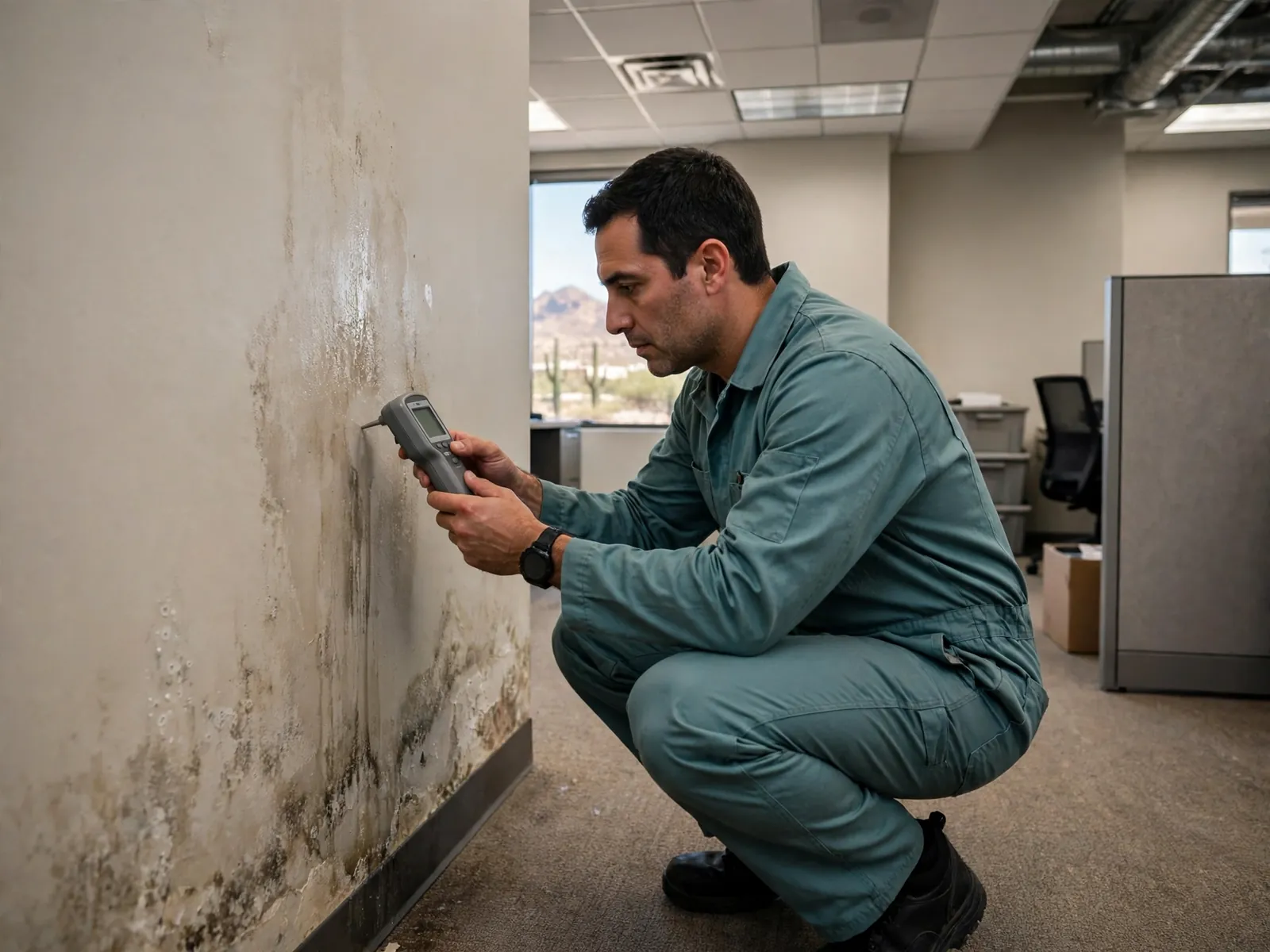
Moisture readings are the second record, and in a commercial job they should cover every affected tenancy, not only the one that called. The readings show what was wet at the start, what the drying plan covers, and what the readings were when the job finished. Keep a copy with the photos, not only with the crew's paperwork.
The third record is the written scope: what work was done, which materials were removed, and what was dried in place. A business insurer asks for this, and a building manager needs it to explain the work to the tenants. If the question of who pays comes up later, the scope is the document that shows what was actually done and why.
The fourth record is the interruption itself: which rooms closed, for how long, and what work moved or stopped. A business interruption claim is built on dates and rooms, not on impressions. Write down the day the water was found, the rooms that closed, the day each room reopened, and the readings that supported each reopening. That log is the claim.
Services used most
Emergency Water Extraction · Water Damage Restoration · Sewage Cleanup
Where we work
Related guides
What To Do First When Water Floods Your Home · How Long Does Water Damage Restoration Take?
Related problems
Frequently asked questions
Questions people ask about water damage in commercial offices, answered plainly.
It depends on how much is wet and which rooms the business needs first. Drying is often phased: rooms that can be isolated and dried reopen first, while the wettest rooms stay closed until the moisture readings show they are dry. The readings decide each reopening — not the look of the surface, and not the calendar.
Often, yes. The wet area is isolated with barriers so the rest of the floor keeps working, and drying equipment is placed to keep walkways clear. Areas with sagging ceilings or wet electrical fixtures are closed off, not worked around. The loudest work is usually scheduled for the hours when the floor is empty.
Report the water, make sure the main supply is shut off if it is safe to do so, and give the crew access — keys, alarm codes, and the location of the risers and shutoffs. Then tell the tenants on the floors above and below what happened, which areas are closed, and how long the equipment will run.
Restroom supply lines and toilet valves on upper floors, shared drain lines, chilled-water lines that run the height of the building, and flat-roof leaks during monsoon bursts. Downtown and Central Avenue buildings add older risers; Tempe and Chandler tech corridors add dense server and equipment rooms; Scottsdale offices add rooftop units and flat roofs.
It depends on the lease and the building documents. The building usually handles shared systems — risers, restrooms on common floors, the roof — while each tenant handles what is inside their own suite. The building manager is the key person on the day of the leak, because they hold the keys and know the shutoffs.
Power to the affected equipment is cut where it is safe to do so, water is kept away from live equipment, and the drying starts only when the room is safe to enter. The moisture readings decide when the room is dry, and the IT team decides when the equipment goes back on. Do not enter a wet server room alone.
Write down the day the water was found, which rooms closed, the day each room reopened, and the readings that supported each reopening. Keep that log with the photos, the moisture readings, and the written scope of the work. A business interruption claim is built on dates and rooms.
Often. Extraction, removal of wet materials, and placement of drying equipment can happen in an evening, with readings taken the next morning before staff arrive. After-hours work needs access — keys, alarm codes, and a contact who can be reached if the crew finds something unexpected.
Walk the restrooms weekly and look for damp floors, musty smells, and stained ceiling tiles below. Know where the main shutoff and the riser closets are, and make sure the building team can reach them. Check flat-roof drains and scuppers before monsoon season, which runs June 15 to September 30, and keep a list of who to call when water is found.
Water damage in your Phoenix home or business?
Call Now to reach a local water damage professional. Describe the water, where it is, and what it has touched.
Call now for water damage help
Tap Call Now to reach a local water damage professional. Tell them where the water is, what it has touched, and whether it is still coming in.
Hours: Mon–Fri 7:00 AM–10:00 PM ET · Sat 8:00 AM–10:00 PM ET · Sun 7:00 AM–9:00 PM ET
Before you call
- Shut off the main water supply if it is safe to do so.
- Move valuables, rugs and electronics off wet floors.
- Take photos of the water and the damage for your records.
- Stay away from wet outlets, switches and light fixtures.
- Note when the water started and what caused it, if you know.